Seasons & Episodes
Inertia
How can physics be about movement if nothing wants to move? Ah, but forces in the universe make things move and stop mo
Mass
This program introduces the kilogram as a way to measure the mass of an object, and proves that small things can me more
Speed
Expert ball-handling proves force varies with mass and speed.
Acceleration (1)
Force varies with mass and rate of change of speed. It's much easier to stop a slow-moving cannonball than a rapid tenn
Acceleration (2)
It takes only a few seconds for something to accelerate to a max speed. This is demonstrated with a vintage locomotive.
Gravity
What is gravity? Through the fictional story of Newton's apple, we learn about gravity and shed some light on weight.
Weight vs. Mass
Physics has to be specific in distinguishing weight from mass. This is why physicists measure weight in newtons.
Work
How much work are you doing? Whatever the force you apply is measured in newton meters–or joules, after James P.
Kinetic Energy
The physics of billiard balls begins the first of two programs on energy itself.
Potential Energy
David and Goliath characters demonstrate how potential energy differs from kinetic energy.
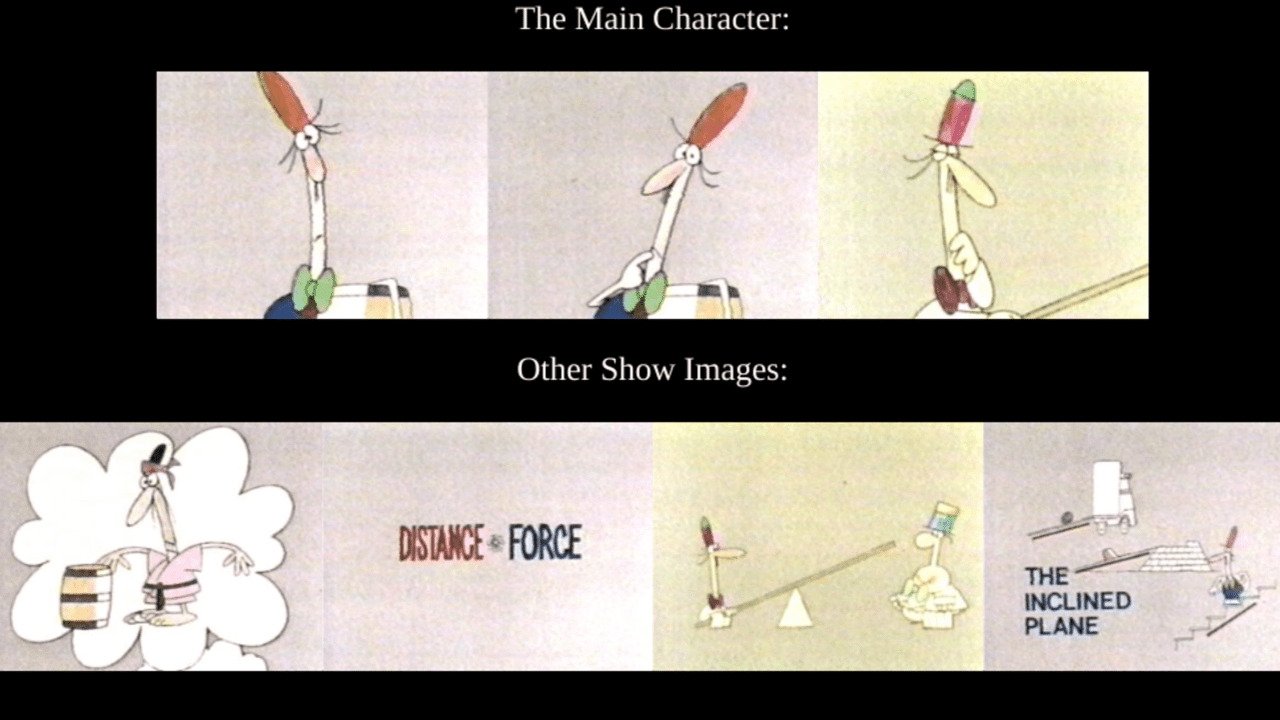
The Inclined Plane
How can someone lift a very heavy load? If one could slice the load into pieces, that would trade increased distance fo
The Lever
A teeter-totter is the perfect demonstration of the lever, particularly if you are trying to ride a teeter-totter with s
Mechanical Advantage and Friction
Two professors compete to see who can lift a book with a lesser amount of force. The professor who uses a lever is more
The Screw and the Wheel
All machines in the world can be traced to just two: the inclined plane and the lever. Even the wheel is just a circula
The Pulley
Jack and Jill went up the hill and found a problem: how can they pull a pail of water from the bottom of a well? In thi
Molecules in Solids
The first of six shows on heat and temperature, introduces molecules. Even though a solid object looks motionless, its
Molecules in Liquids
This episode sacrifices a chocolate rabbit on a hot day to illustrate the movement of molecules in liquids.
Evaporation and Condensation
No end of problems await the man who keeps fish for pets. Evaporation forces one to refill the tank. And he who thinks
Expansion and Contraction
This lecture-packed show compares a balloon to a bunch of angry wasps to explain why gases expand and contract. It goes
Measuring Temperature
Given three bathtubs of varying temperature, the star of the show ""blunts"" his feet so that they can't tell temperatur
Temperature vs. Heat
What is better to warm up a kiddie pool: a teacup of boiling water (100° Celsius) or a bucket of water at 50° Celsius?
Atoms
There's more to matter than the molecules we had spent discussing in the previous six shows. This fourth unit produces
Electrons
An atom is made of mostly empty space. The electrons in an atom zoom around at fantastic speeds to create existence out
Conduction
All objects conduct heat, of course, but get a look at objects from the atomic level and you'll see why some objects con
Volume and Density
To set up audiences for The Convection of Heat, this question is posed: how can you fit eight junky cars into a small sp
Buoyancy
How come an anchor is easier to lift if it's in the water than in open air? It lies in the density of an object versus
Convection
Now that the Principle of Buoyancy is understood, one can fully grasp The Convection of Heat. This is demonstrated with
Heat as Energy
An animated Count Rumford demonstrates, for the first time, how heat can be used to produce energy. The show converts a
Radiation Waves
Why does somebody stand in the shade on a hot day? This show introduces the third method by which heat can be transferre
The Radiation Spectrum
Is it just your imagination that you are warmer when you wear dark clothes over white clothes? That actually sets off a
Popular Cast


Related TV Series

Martha Speaks
Dinosaur Train

Little Bill
Rugrats

George of the Jungle

Fish Hooks

Eek! The Cat

What a Cartoon!
Peppa Pig
Snorks

King of the Hill
Krapopolis
Mickey Mouse Clubhouse

The Critic
Back at the Barnyard

CoComelon Lane
Alvinnn!!! and The Chipmunks
The Wacky World of Tex Avery
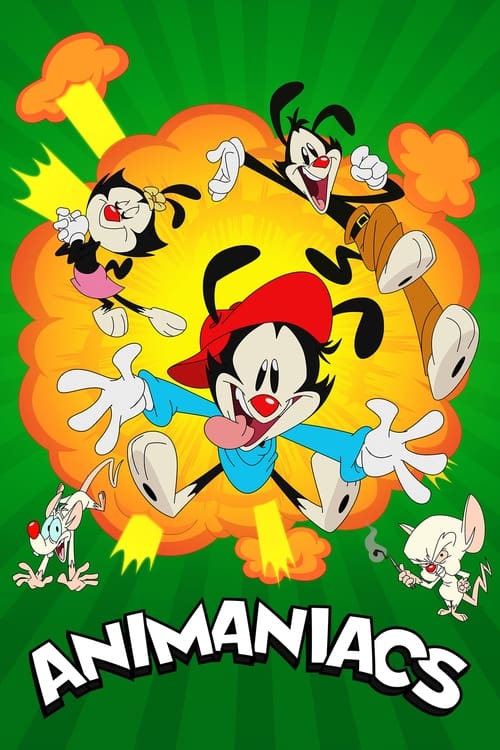
Animaniacs